Why the Sock Gap Shortens Petite Legs, and 3 Ways to Close It
Quick Answer: Every visible band at your ankle — hem edge, strip of skin, sock cuff, shoe collar — is a horizontal line, and each horizontal line subtracts from the vertical run the eye can travel. On a petite leg, three inches of striped interruption can consume a tenth of the visible leg. The three closers: eliminate the sock from view entirely (no-show socks, hem to the shoe), merge sock and shoe into one tonal block, or merge sock and legging into one column. Each works; mixing them halfway is what produces the gap.
The ankle is the cheapest real estate in proportion styling — and late summer, the season of crops and sneakers, is when it is most expensive to ignore.

What is the sock gap actually doing to your leg line?
Slicing the shortest visible distance into the most segments.
The eye reads leg length as the longest uninterrupted vertical run it can find between waist and floor. Every horizontal boundary — a hem edge, a color change, a cuff — ends one run and starts another, and the eye sums the longest segment, not the total. One clean 30-inch column reads longer than 34 inches chopped into four pieces.
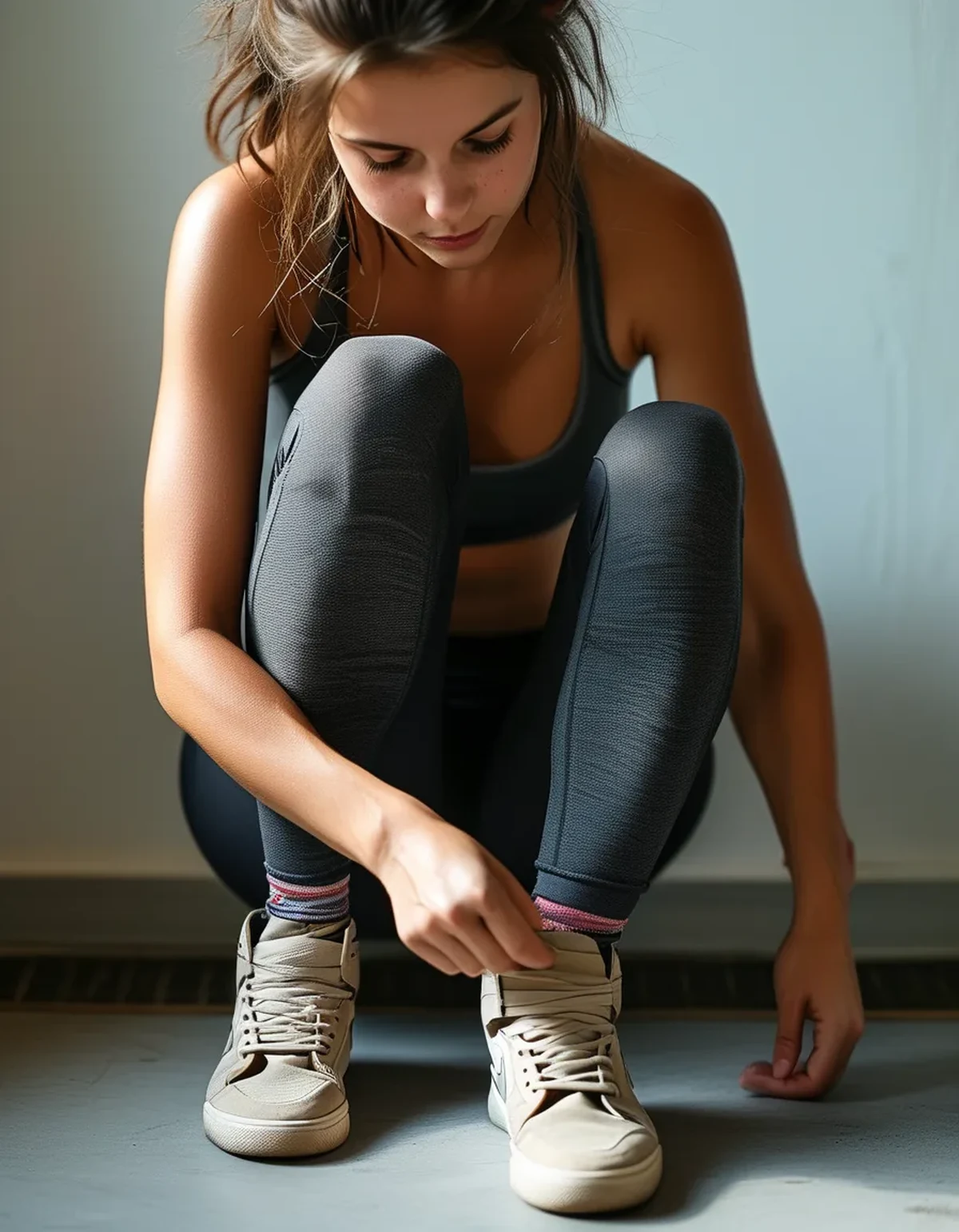
Now audit the classic late-summer ankle: cropped leggings ending at the shin, two inches of skin, a white sock cuff, a dark shoe collar. Four boundaries inside a three-inch zone, each with real contrast — fabric to skin, skin to white knit, white to shoe. The final segment before the floor, the one that anchors the whole impression, has been shredded into stripes.
Why petite frames pay more: the interruption is fixed-size, the leg is not. Three inches of visual noise on a 34-inch leg costs under a tenth; on a 28-inch leg it approaches a full ninth of the visible line — and it sits at the base of the column, where the eye finishes and forms its verdict.
The sock is the only one of the four bands with no structural job in the outfit’s appearance. It is pure interruption — which is exactly why it is the easiest win available.
Why does this beat most proportion tricks you already use?
Because it works at the high-leverage end of the line, for pocket change.
Proportion advice concentrates at the top of the body — rise height, tuck strategy, where the waist reads. All real. But the ankle decides how the line ends, and endings carry disproportionate weight in what the eye remembers. A high-waisted outfit that dissolves into ankle stripes starts the column beautifully and finishes it in static.
Consider the asymmetry of effort: relocating your visible waistline means rethinking tops, rises, and belts across a wardrobe. Closing the sock gap means changing which sock you reach for — a decision that costs nothing, requires no new silhouettes, and repeats automatically every morning once the drawer is sorted.
There is also a fashion-cycle reason this matters right now. The visible-sock look — white crew over legging, sock scrunched at the sneaker — cycles in and out of trend, and it photographs charmingly on the 5’10 frames it was styled on. Adopted at petite scale, the same styling spends leg the wearer does not have spare. Trends are priced in inches, and the price varies by leg.
None of this argues for abandoning visible socks as a look — it argues for knowing the cost and choosing deliberately. The three closers that follow include one that keeps the sock entirely visible and still protects the line.
What are the three ways to close the gap?
Three strategies, from invisible to statement — pick one per outfit and commit.
Closer one: remove the sock from the picture. No-show socks below the shoe collar, and a hem that finishes the job — full-length leggings or trousers ending within an inch of the shoe. This is the cleanest line available: fabric flows to shoe, one boundary total. It is also the strategy that makes bootcut leggings so reliable on petite frames — the flared hem breaks over the shoe and deletes the entire ankle zone from view. The catch: the hem must actually reach; a crop plus no-shows still leaves a skin band, which reads fine in summer but surrenders the merge.
Closer two: merge sock into shoe. When you want ankle coverage — cooler mornings, blister management, high-top sneakers — match the sock to the shoe: white sock into white sneaker, cream into cream, black into black. Cuff and collar fuse into one taller shoe block, and four boundaries drop to two. This is the everyday-sneaker answer for September walking.
Closer three: merge sock into legging. The visible-sock look, done at petite-friendly cost: a sock in the same color family as the legging — black over black, espresso over dark brown — continues the column down into the shoe. The tonal ribbed-sock-over-legging pairing reads current and deliberate while keeping one continuous run. This is how to wear the trend without paying its full price.
The one unforced error to retire: the high-contrast sock band matching nothing — the white cuff between dark legging and dark shoe. It is the maximum-cost version, and it is the default that drawers keep dealing.
Myth vs Fact: Ankles and the Leg Line
Myth: Nude shoes are the whole answer for petite legs. Fact: Skin-tone shoes extend the line only when the ankle above them is clean. A nude shoe under a contrast sock cuff buys nothing — the line already broke above the shoe. Sock strategy comes first; shoe tone compounds it.
Myth: Ankle socks are automatically safer than crew socks. Fact: A visible ankle-sock cuff cuts at the narrowest, most noticeable point. A crew sock tonal to the legging preserves the column better than a contrast ankle sock. Height matters less than contrast.
Myth: In summer, bare ankles always lengthen most. Fact: With shorts and skirts, yes — skin is the column. Under cropped leggings, a skin band between fabric and shoe is one more stripe; tonal continuation regularly beats bare there.
Myth: Sock color is too small a detail to register. Fact: The eye lands twice at the ankle in a typical glance — arriving and leaving. Small zone, disproportionate airtime, which is exactly why the fix outperforms its effort.
Myth: This only matters with sneakers. Fact: Loafers with contrast socks, boots with a gap band at the shaft, mary-janes over white ankle socks — every closed shoe runs the same math. The sneaker version is simply the one worn most days.
FAQ: Sock Gap Questions, Answered
What exactly should I buy to run all three closers?
A no-show set with silicone heel grips (closer one), socks matching each of your two main sneaker colors (closer two), and two or three ribbed pairs in your dominant legging colors (closer three). Under fifteen dollars, covers every outfit you own.
My no-shows slip into my heel by noon. Fix?
Size up in the sock, buy cuts with heel silicone and a deeper toe pocket, and match the cut to the shoe — sneaker-depth no-shows for sneakers, ultra-low for loafers. Slipping is a cut mismatch, not a category flaw.
Does the tonal-column rule change with flare and bootcut hems?
Flares handle the whole problem themselves — the hem covers sock and collar, so wear whatever sock is comfortable. The strategies matter most with straight crops, joggers, and anything ending above the shoe.
Cooler mornings are coming — how does this translate to boots and tights season?
Same principle, easier execution: tights matched to boot shaft, or trouser hem meeting boot top, builds one column with zero gap band. The sock gap is mostly a warm-weather tax — which is why closing it now, in crop season, is when it pays.
TL;DR:
- The eye reads the longest unbroken vertical run; hem-skin-sock-shoe stripes shred the final segment — at fixed cost on a shorter leg, so petites pay proportionally most.
- Closer one: no-shows plus hem to the shoe (bootcut hems do it automatically). Closer two: sock merged into shoe. Closer three: sock merged into legging for the visible-sock look at petite prices.
- Retire the contrast cuff that matches nothing — it is the maximum-cost default.
- Boots-and-tights season runs the same math with easier tools; sort the sock drawer before it arrives.
Tomorrow, wear your usual crop-and-sneaker outfit twice in the mirror — once with the white cuff, once with a tonal sock. The two reflections are inches apart, and the difference cost you a sock.
See It in Motion
Seen here: Bootcut Yoga Pants with Side Pockets — shop it on bubblelime.com
Keep Reading
This article is for general informational and styling purposes only. Fit, sizing, and product availability may vary.
