Why Does Layering Shorten Petite Legs?
Quick Answer: Apparent leg length is set by the lowest strong horizontal break on the body. Each additional layer — a hem, a cuff, a waistband, a colour change — adds another candidate for that break, and the lowest one wins. Autumn layering typically adds two or three new hems, which is why the same trousers that lengthened in summer stop working in October. The fix is controlling where hems land, not wearing fewer layers.
Summer was easy. One top, one bottom, one line.
Then the temperature dropped and you added three more.
This is general information, not medical advice.
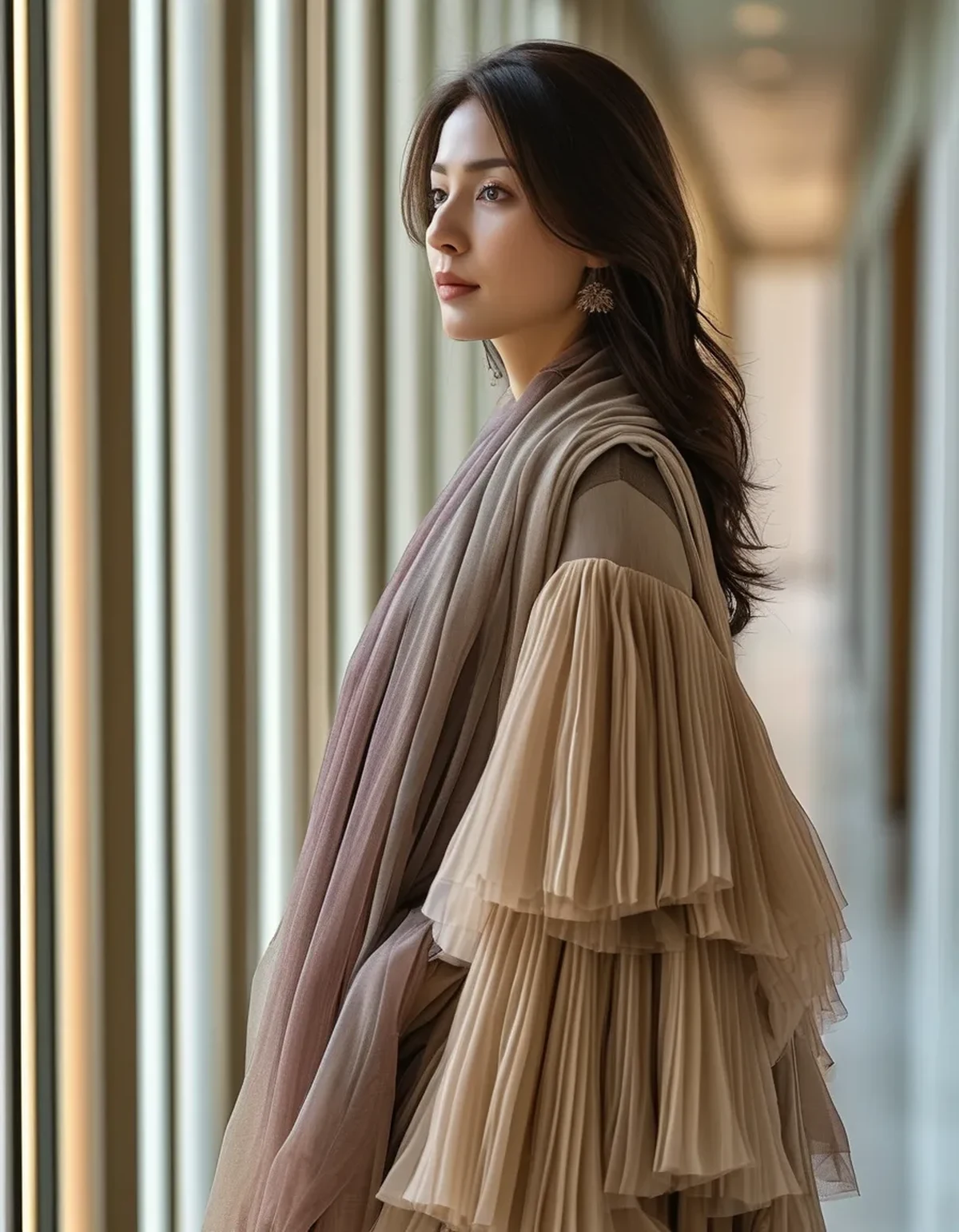
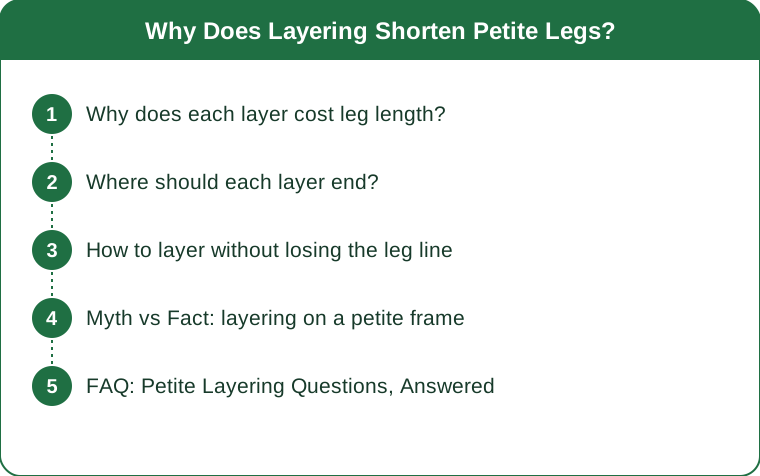
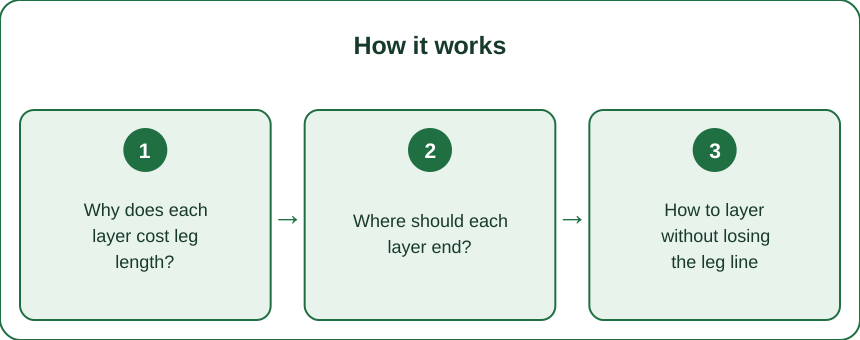
Why does each layer cost leg length?
Because the eye reads the lowest strong horizontal line as the top of the legs, and layers create horizontal lines by definition.
A single top tucked into trousers gives you one break, at the waist. Add an open cardigan, and its hem creates a second line, lower. Add a jacket over that, and there is a third. Whichever sits lowest and has the most visual contrast becomes the one your eye uses.
This is why the arithmetic of autumn dressing works against a shorter frame specifically. A tall frame has enough vertical distance that several horizontal lines still leave visible leg below. A shorter frame does not — the same three lines occupy a much greater share of the total height, and the lowest one may sit barely above the knee.
The severity of each line depends on three factors:
Contrast. A cream cardigan over a navy top over black trousers creates two high-contrast lines. The same three pieces in one tonal family create almost none.
Hem weight. A stiff, structured hem with a defined edge reads as a hard line. A soft draping hem in fine knit reads as a suggestion.
Where it lands. A hem at the natural waist barely registers as a break because it coincides with where the eye already expects the division. A hem at mid-thigh is the most costly position available.
Does that mean fewer layers is the answer?
It is an answer and rarely a practical one in autumn. Controlling contrast and hem position achieves the same result while staying warm.
Where should each layer end?
There are two positions that work and one that consistently does not.
Position one: at or above the natural waist. A cropped cardigan, a short jacket, or a tucked layer that ends at the narrowest part of the torso. This puts the break at the highest available point and starts the leg line there. For a petite frame this is the strongest lengthening option.
Position two: long enough to become a column. A long open cardigan or coat that falls well below the hip creates two strong vertical lines down the front of the body rather than a horizontal one across it. The eye follows the verticals. This works because the garment is read as a frame rather than as a hem.
The position that fails: mid-hip to mid-thigh. This is where most standard-length cardigans, sweatshirts, and jackets end, and it is the worst available place for a shorter frame. It draws the line at the widest part of the body and starts the legs from the lowest plausible point.
The practical consequence is that the two extremes work and the middle does not. When shopping, the question is not whether a layer is flattering in isolation — it is whether the hem lands in the short zone or the long zone rather than in between.
What about layers you cannot change, like a work jacket?
Open it. An open jacket creates vertical lines; a closed one creates a horizontal hem. This single choice changes most mid-length outerwear from the failing category into the column category.
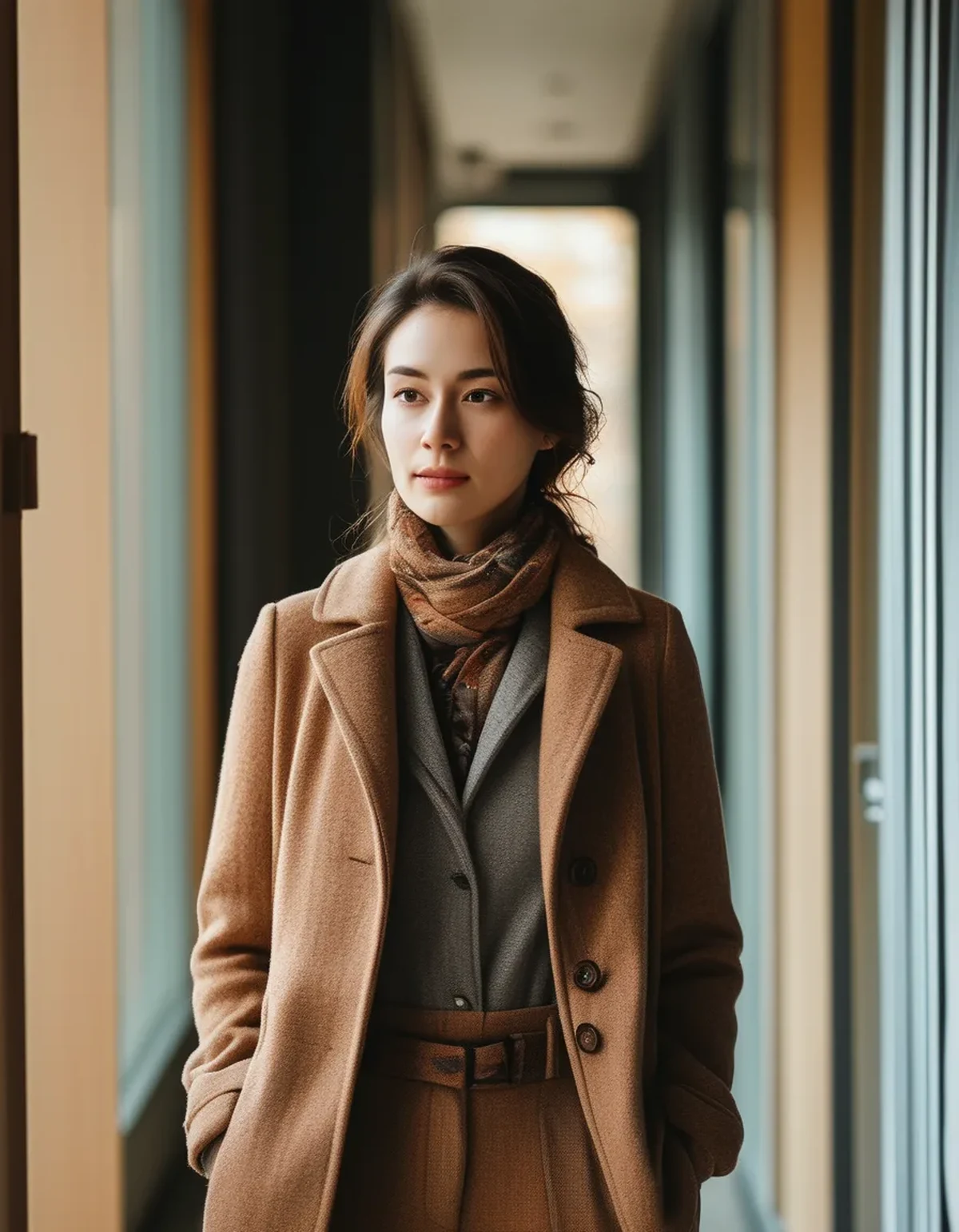
How to layer without losing the leg line
1. Keep the innermost layer tucked and high. Whatever is next to your body should end at or above the natural waist, tucked or fitted. This establishes a high break before anything else is added.
2. Match tones between layers. The layers do not need to be identical, and keeping them in one tonal family removes most of the contrast that creates hard lines. A charcoal knit over a black tee over black trousers has three hems and almost no visible breaks.
3. Match the bottom layer to your shoes. Continuing the trouser colour into the shoe extends the leg column downward, which offsets some of what the layers cost at the top. Tights or socks matching the shoe do the same job with a skirt.
4. Pick one length and commit. Either all short layers or one long one. The failure mode is a short jacket over a mid-length cardigan over a long tee — three hems at three different heights, which is the most visually chopped configuration possible.
5. Use vertical elements deliberately. An open cardigan, a long scarf hanging straight rather than looped, or a front placket all draw the eye vertically and counteract the horizontals.
6. Put volume above the waist, not below it. A fuller top layer with slim bottoms keeps the leg line clean. Volume on both halves reads as scale, and scale is what overwhelms a shorter frame.
What about a scarf?
A scarf hanging in two long vertical lines lengthens. A bulky loop around the neck shortens the visible torso and pushes everything down. The same scarf, worn two ways, produces opposite results.
Myth vs Fact: layering on a petite frame
Myth: Petite frames should not wear long coats. Fact: Long and slim works well, because it creates a vertical column. What fails is long and bulky, and mid-length in a contrasting colour. Length itself is not the problem.
Myth: You should wear fewer layers. Fact: You should wear layers that land in the right places. A well-organized four-layer outfit lengthens more than a badly organized two-layer one.
Myth: Monochrome is boring. Fact: Tonal dressing does not mean identical. Varying texture — a ribbed knit, a smooth shell, a matte trouser in one colour family — gives visual interest without introducing horizontal breaks.
Myth: Cropped layers are only for showing your midsection. Fact: A cropped cardigan over a tucked top shows no skin at all. It simply places the hem at the natural waist, which is where the break is cheapest.
Myth: Heels solve it. Fact: Heels add height and do nothing about where the horizontal lines fall. A well-layered flat outfit frequently reads longer than a badly layered outfit in heels.
Myth: The trousers are what determine leg line. Fact: Rise matters and the layers above it usually matter more, because they control the lowest visible break — and that is what the eye actually uses.
FAQ: Petite Layering Questions, Answered
What is the single most useful autumn layer to own?
A cropped or waist-length knit in a tone matching your most-worn trousers. It adds warmth without adding a low horizontal line, which is the exact problem autumn creates.
Should I avoid belted layers?
Not at all — a belt at the natural waist over a layer actively helps, because it creates a high break and defines the shape. The mistake is belting at the hip.
How do I handle a work environment that requires a blazer?
Open, and ideally in a tone close to the trousers. A single-breasted blazer worn open creates strong verticals; the same blazer buttoned creates a hem at the hip.
What about oversized knitwear, which is everywhere right now?
It works with slim bottoms and a visible sliver of ankle or shoe, and with the sleeves pushed up so the arms are not swamped. Oversized on top and wide on the bottom is where it goes wrong.
Does this apply to skirts and dresses too?
Yes — the layer hem and the skirt hem are two horizontals in close proximity, which is the choppiest arrangement. Keeping the layer distinctly shorter than the skirt, or distinctly longer, resolves it.
What is the fastest test?
Photograph the outfit and squint at the picture. The lines you can still see when the detail blurs are the lines the eye is actually using.
TL;DR:
- Apparent leg length is set by the lowest strong horizontal line, and every layer adds a candidate.
- Two positions work: at or above the natural waist, or long enough to read as a vertical column.
- Mid-hip to mid-thigh is the costly zone, and it is where most standard layers end.
- Tonal layering removes most of the contrast that makes hems into hard lines.
- Wear mid-length outerwear open — verticals instead of a hem.
You do not need fewer layers in October. You need the hems to land in two places instead of four.
This is general information, not medical advice.
Keep Reading
This article is for general informational and styling purposes only. Fit, sizing, and product availability may vary.
