Why One Color Head to Toe Beats Every Other Leg-Lengthening Trick
Quick Answer: Every leg-lengthening trick works by removing or moving a horizontal break. A monochrome column removes all of them at once — waistband, hem, and shoe line disappear when the tones match. Because the eye cannot find a boundary, it reads one continuous vertical shape instead of stacked segments, which is why the effect is larger than the sum of individual tricks.
You raised the rise, you bought the pointed flats, you shortened the jacket.
Then you wore one color from shoulder to shoe and it did more than all three.
Why does removing color breaks matter so much?
Because the eye measures proportion by finding boundaries, and no boundary means no measurement.
Every color change is a horizontal line. A dark top over light trousers creates a line at the waist. Light trousers over dark shoes create a line at the ankle. Each line divides the body into a segment the eye reads separately.
Segments get compared to each other. When the eye sees a torso segment and a leg segment, it judges their relative lengths. Remove the divider and there is nothing to compare — the whole shape reads as one unit.
Individual tricks move one line; monochrome removes all of them. A high rise moves the waist line upward, which helps. But the hem line and the shoe line are still there. Monochrome eliminates the entire set simultaneously.
This is why the effect is multiplicative rather than additive. Removing three boundaries does not help three times as much as removing one — it changes what the eye is doing entirely, from measuring segments to tracing a single line.
It is the reason monochrome is the standard advice from stylists while individual tricks get discussed more. Individual tricks are more interesting to talk about; the column just works.
Does it have to be exactly the same color?
No, and the tolerance is more forgiving than most people assume.
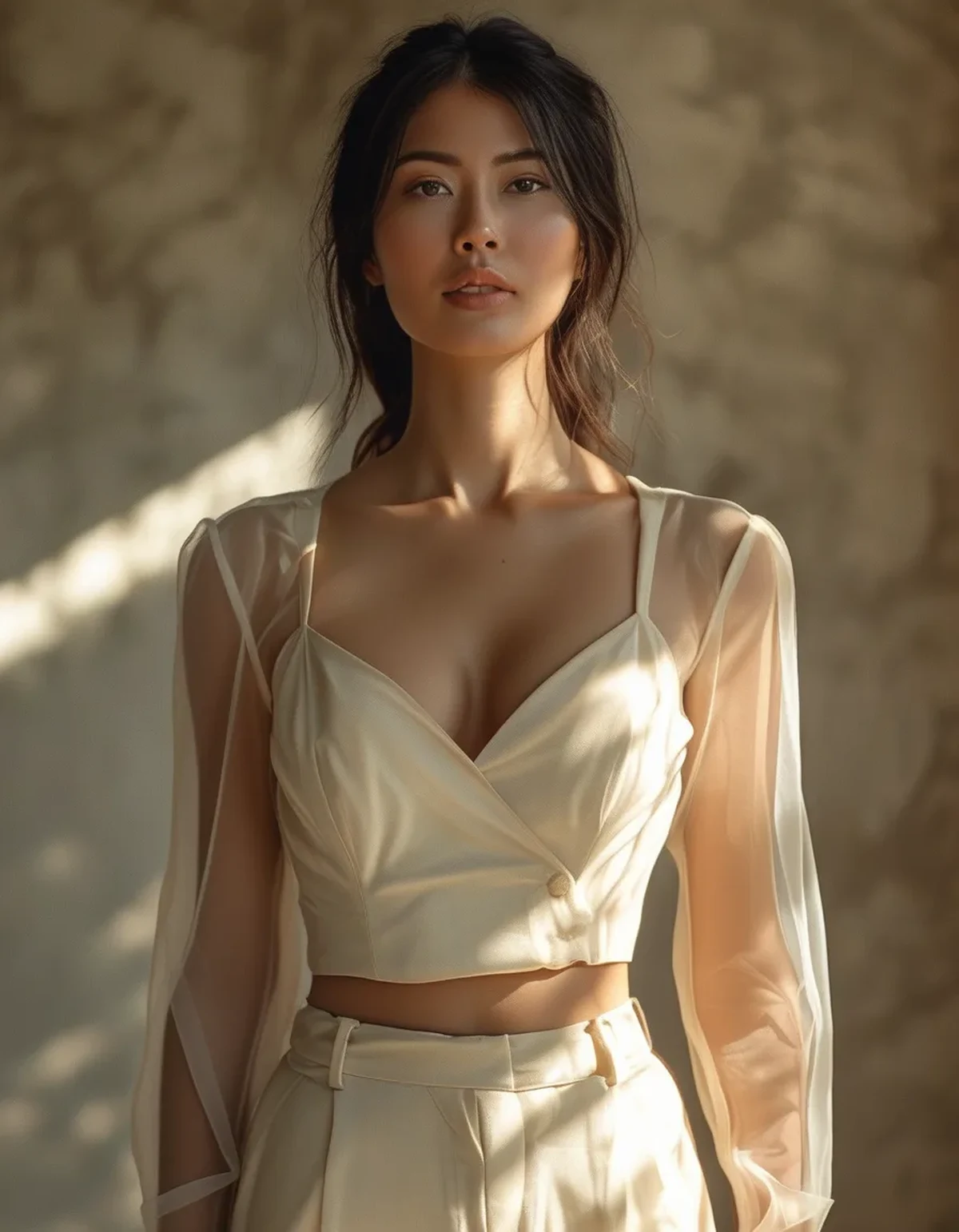
Tonal beats exact. Shades within the same family — charcoal with black, camel with cream, two adjacent navies — read as continuous at normal viewing distance. Exact matching across different fabrics is nearly impossible anyway, since the same dye reads differently on knit and woven.
The threshold is contrast, not hue. What breaks the column is a noticeable jump in lightness. Two different colors of similar depth — a deep olive and a deep brown — hold the column better than two shades of the same color at very different lightness.
Texture variation is actively good. A ribbed knit with a smooth trouser in the same tone adds interest without adding a boundary, which is what stops the look reading flat.
Shoes are where most columns break. A perfect tonal outfit ending in contrasting shoes reintroduces the ankle line and loses most of the benefit. If you only match one thing to the trouser, match the shoe.
Seasonal note: autumn makes this dramatically easier. Opaque tights matched to boot color create the column from hem to floor, which is why the same person looks taller in a fall outfit than in a summer one with sandals and a contrasting bare ankle.

What Nobody Tells You About the Column
Black is the easiest column and not the most flattering one. All-black works and everyone knows it works, which is why it is everywhere. But a mid-tone column — camel, olive, soft grey — often reads better on a petite frame, because black can flatten shape entirely and lose the waist definition that also contributes to a longer leg line.
A third piece can extend the column instead of breaking it. A long open cardigan or coat in the same tone adds two vertical lines down the sides and reinforces the effect. In a contrasting color, the same piece cuts the column into thirds. The layer is not the problem; the color of the layer is.
A belt in the same tone is invisible and a belt in contrast is a hard stop. If you want waist definition without losing the column, match the belt. If you deliberately want to mark the waist high, use contrast — but do it knowing you are trading some leg length for shape.
The bag breaks it more than people realize. A contrasting bag hanging at hip height introduces a strong visual element exactly at the point where you were trying to remove one. A crossbody strap does the same thing diagonally across the torso.
Photographs show the effect far more clearly than mirrors. Mirrors give you a downward angle at close range, which flattens proportion differences. A full-length photo from ten feet away shows the column effect at something like the strength other people actually see.
How do you build one from what you already own?
Start with the bottom half and work up, since that is where the leg-lengthening happens.
Pick the trouser or legging first. Whatever tone that is becomes the column’s base color. Working from the bottom up is more practical than picking a top and hunting for matching bottoms.
Match the shoe to the trouser before anything else. This single pairing does more than matching the top does, because the ankle boundary is the one closest to the leg-length judgment.
Get the top within a shade or two. Same family, similar depth. Do not chase an exact match — it is unnecessary and usually impossible.
Use texture for interest. A knit top, a smooth trouser, a suede shoe, all in one tone, is far more interesting than three smooth pieces and reads as deliberate rather than accidental.
Break the column on purpose at the top, not the middle. A scarf, a necklace, or a contrasting jacket collar draws the eye upward to your face while leaving the vertical line below intact. That is the version of contrast that costs nothing.
FAQ: Monochrome Dressing, Answered
Does this only work with dark colors?
No. A light column — cream with off-white, or soft grey throughout — works on exactly the same principle. Light columns show fit issues more clearly because there is no shadow to hide them, so they demand a better fit, but the lengthening effect is the same.
Will it look boring or like a uniform?
Only if the textures are identical. Varying texture and adding one deliberate accent at the neckline is what separates a considered column from a tracksuit. The effect people describe as boring is usually three matte pieces with no accent.
Is this worth reorganizing my wardrobe around?
You do not need to. Most people already own two or three tonal families that could form columns — they simply have never combined the pieces because they were bought as parts of different outfits. Spend twenty minutes pulling everything in one tone together and you will usually find two complete columns you did not know you had.
TL;DR:
- Every color change is a horizontal break; the column removes all of them at once
- Tonal beats exact matching — what matters is lightness contrast, not identical hue
- Match the shoe to the trouser first; the ankle boundary costs you the most
- Vary texture to keep it interesting, and put any deliberate contrast up at the face
- Fall makes it easy: matched tights and boots build the column from hem to floor
The reason this beats every individual trick is that it is not a trick — it is removing the thing all the other tricks are working around. Build it from the shoes up and it works without any of the fine-tuning.
Keep Reading
This article is for general informational and styling purposes only. Fit, sizing, and product availability may vary.
