Why Print Scale Changes the Petite Leg Line More Than Color Does
Quick Answer: A print creates repeating visual units, and the eye counts them. A large-scale print puts two or three units on your leg, which segments it into visible chunks and shortens the line. A fine print reads as texture rather than pattern, so the leg stays a single continuous surface. Scale relative to your body is what matters - the same print that reads small on a taller frame reads medium on a petite one, which is why print scale is a proportion decision, not a taste one.
And it explains why the monochrome advice sometimes fails despite being followed correctly.
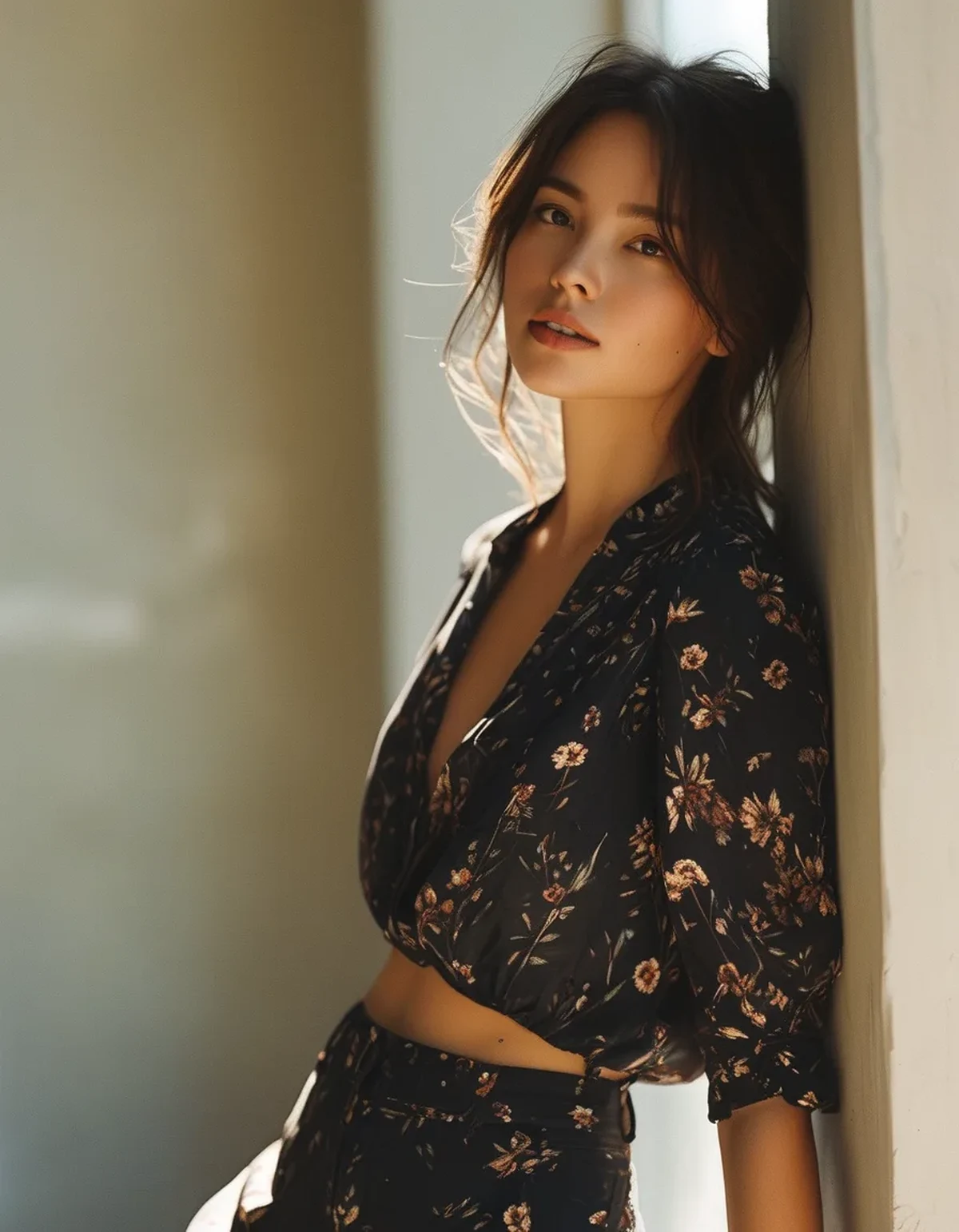
Why does print scale affect leg length so much?
Because pattern gives the eye something to count, and counting creates divisions.
The eye segments a surface at repeating boundaries. A large motif with clear edges creates a visible unit. Three units down your leg means the eye reads three sections rather than one continuous line - and a segmented leg reads shorter than an uninterrupted one.
Fine prints avoid this by blurring into texture. Below a certain size, the individual motifs stop being separately visible at normal viewing distance. The eye stops counting and starts reading the surface as one tone with texture - which behaves exactly like a solid color for proportion purposes.
Scale is relative to the body, not absolute. A 6cm floral is a small print on a 180cm frame with a long leg and a medium print on a 155cm frame. This is the part that gets missed - print scale advice given in absolute terms fails because the reference point is your leg length, not a ruler.
Contrast within the print matters as much as size. A large motif in tones close to the background reads softer than a small motif in high contrast. A tiny black-and-white polka dot can read as a stronger pattern than a large tonal floral, because contrast is what makes edges visible.
And direction interacts with scale. A vertical print at a fine scale is the strongest lengthening combination available. A horizontal element at a large scale is the weakest, which is the one case where the old advice about horizontal stripes is genuinely correct.
What scale actually works on a petite frame?
Practical guidance rather than a rule, since it depends on the print.
As a rough guide: motifs smaller than about 3 to 4cm tend to read as texture on most petite frames at normal conversational distance. Above about 8cm, they read clearly as separate units and segment the leg.
The squint test is more reliable than any measurement. Stand at arm’s length from a mirror and squint. If the pattern blurs into a single tone, it will behave like a solid. If you can still see distinct shapes, it will segment.
Or the photograph test. Take a full-length photo and look at it at phone size. A print that reads as texture in a small image is a fine print for your frame - which is also roughly how other people see you across a room.
Placement matters as much as scale. A large print on a top and a solid on the bottom keeps the leg line intact while still giving you the pattern. This is the compromise that lets you wear prints you love without the proportion cost.
Vertical repeats are more forgiving of scale. A larger motif arranged in vertical columns lengthens where the same motif scattered randomly shortens. Look at the repeat structure, not just the individual shape.
And borders are the specific thing to avoid. A border print with a horizontal band at the hem is the single strongest leg-shortening pattern element there is, because it places a hard horizontal at the bottom of the leg - the eye reads the leg as ending at the band rather than the hem.
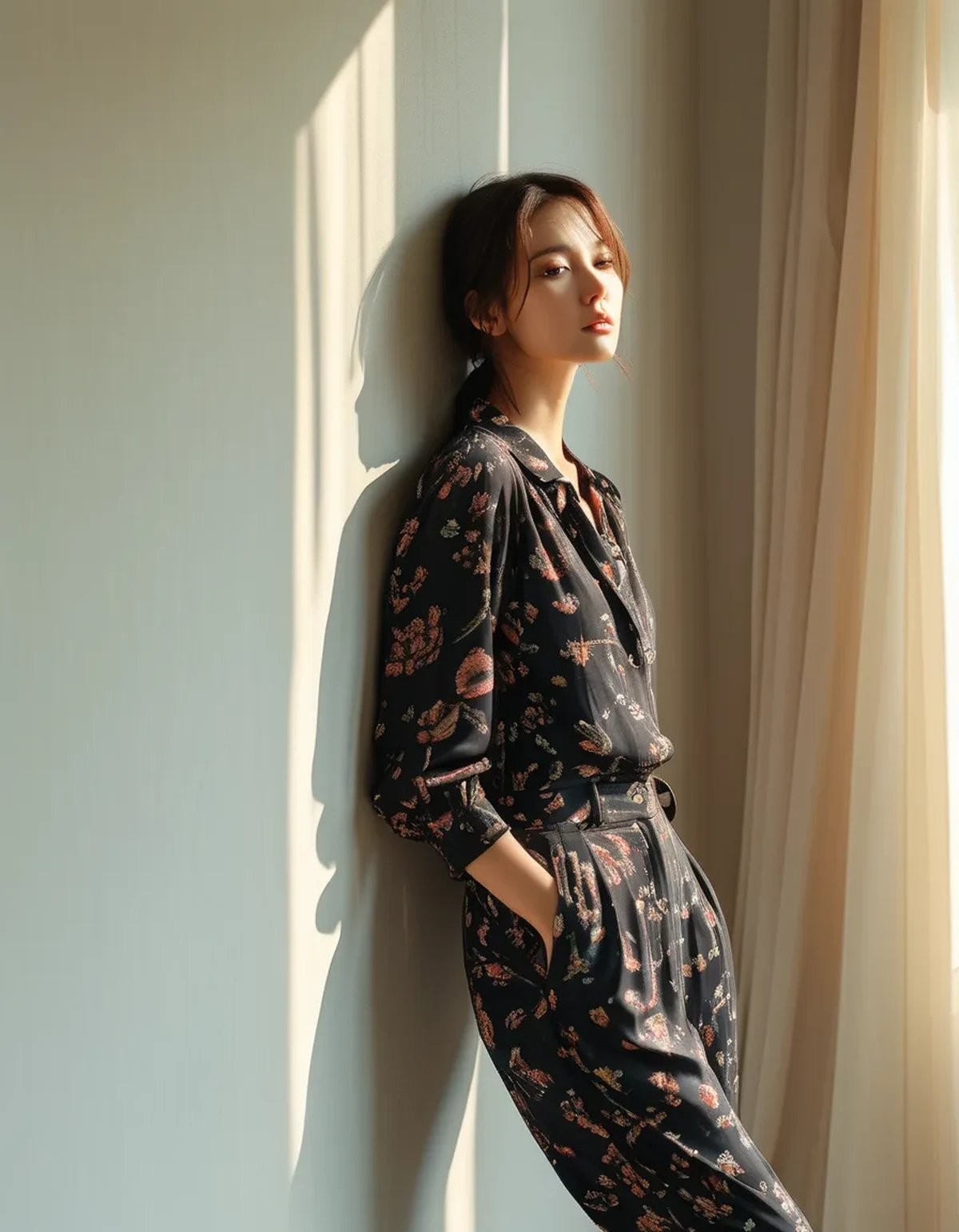
Myth vs Fact: Prints and Proportion
Myth: petite frames should avoid prints. Fact: they should choose scale deliberately. Fine prints are among the best options available - they add interest without segmenting, and they hide fabric imperfections that a solid shows.
Myth: vertical stripes always lengthen. Fact: fine vertical stripes lengthen. Wide vertical stripes with high contrast create their own segmentation across the body and can widen more than they lengthen. Scale governs the stripe rule too.
Myth: dark colors matter more than print. Fact: color and print are separate variables and print scale usually wins. A large print on a dark base can shorten more than a mid-tone solid.
Myth: any small print is safe. Fact: contrast matters as much as scale. A tiny high-contrast print can read as strong pattern and behave like a larger one. Tonal prints of the same size read much softer.
Myth: this is only about trousers. Fact: it applies to any long vertical surface. A print dress, a long skirt, and a full-length legging are all affected identically, and the same squint test works on all of them.
How do you use prints deliberately?
Five practical approaches for a petite frame.
1. Print on top, solid on bottom. The most reliable structure. The leg line stays uninterrupted and the pattern is at eye level, which is where you want attention anyway.
2. If print on bottom, keep it fine and tonal. Small motifs in colors close to the base. This reads as an interesting solid, which is exactly the goal.
3. Match the print’s background to your shoe. If the base tone of the print continues into the shoe, the leg line extends past the hem - the same monochrome principle applied to a patterned fabric.
4. Use vertical repeats where possible. Check how the motifs are arranged, not just their size. Columnar arrangements lengthen; scattered arrangements do not.
5. Avoid border prints at the hem. A horizontal band at the bottom of a trouser or skirt is the strongest shortening element available. A border at the top of a top, by contrast, is fine.
And a note on full print outfits: a head-to-toe print in a fine tonal scale is genuinely lengthening - it works exactly like monochrome, because there is no color break at the waist. The same outfit in a large-scale print is the least lengthening option on the list. Same idea, opposite result, decided entirely by scale.
As autumn prints arrive - checks, florals, animal prints - the scale question is the one worth asking in the changing room. Squint at it. If it blurs, it works.
FAQ: Print Scale and Petite Frames, Answered
What size print counts as small?
Roughly under 3 to 4cm on most petite frames, though contrast changes it. The squint test is more reliable than a measurement - if the pattern blurs into a single tone at arm’s length, it will behave like a solid.
Do vertical stripes really lengthen?
Fine ones do. Wide, high-contrast vertical stripes create their own segmentation across the body and can work against you. Scale governs this rule too.
Can I wear a large print at all?
Yes - on top, or as a single statement piece with solids elsewhere. The cost is specifically to the leg line, so keeping large prints above the waist avoids it entirely.
Is a head-to-toe print a good idea?
In a fine tonal scale, yes - it works like monochrome, with no break at the waist. In a large scale, it is the least lengthening option available.
What is a border print and why avoid it?
A print with a horizontal band along the hem. It places a hard horizontal at the bottom of the leg, so the eye reads the leg as ending at the band rather than the hem. It is the strongest shortening element in patterning.
Does this apply to leggings too?
Yes, identically. Any long vertical surface behaves the same way - trousers, leggings, long skirts, and maxi dresses all follow the same scale rules.
TL;DR:
- Prints create repeating units the eye counts - two or three units down a leg segments it and shortens the line.
- Fine prints blur into texture at normal distance and behave like solids.
- Scale is relative to your leg length, not absolute - the same print reads differently on different frames.
- Contrast matters as much as size: a tiny high-contrast dot can read stronger than a large tonal floral.
- Best structure: print on top, solid or fine tonal print on the bottom, with the print’s base tone matched to your shoe.
- Avoid border prints at the hem - a horizontal band at the bottom of the leg is the strongest shortening element there is.
Use the squint test in the changing room. If the pattern blurs into a single tone, it will lengthen. If you can still count the shapes, it will not.
See It in Motion
Seen here: Super High Waist Embossed Yoga Leggings with Inner Pocket — shop it on bubblelime.com
Keep Reading
This article is for general informational and styling purposes only. Fit, sizing, and product availability may vary.
