Why a Vertical Seam Lengthens Petite Legs More Than a Vertical Stripe
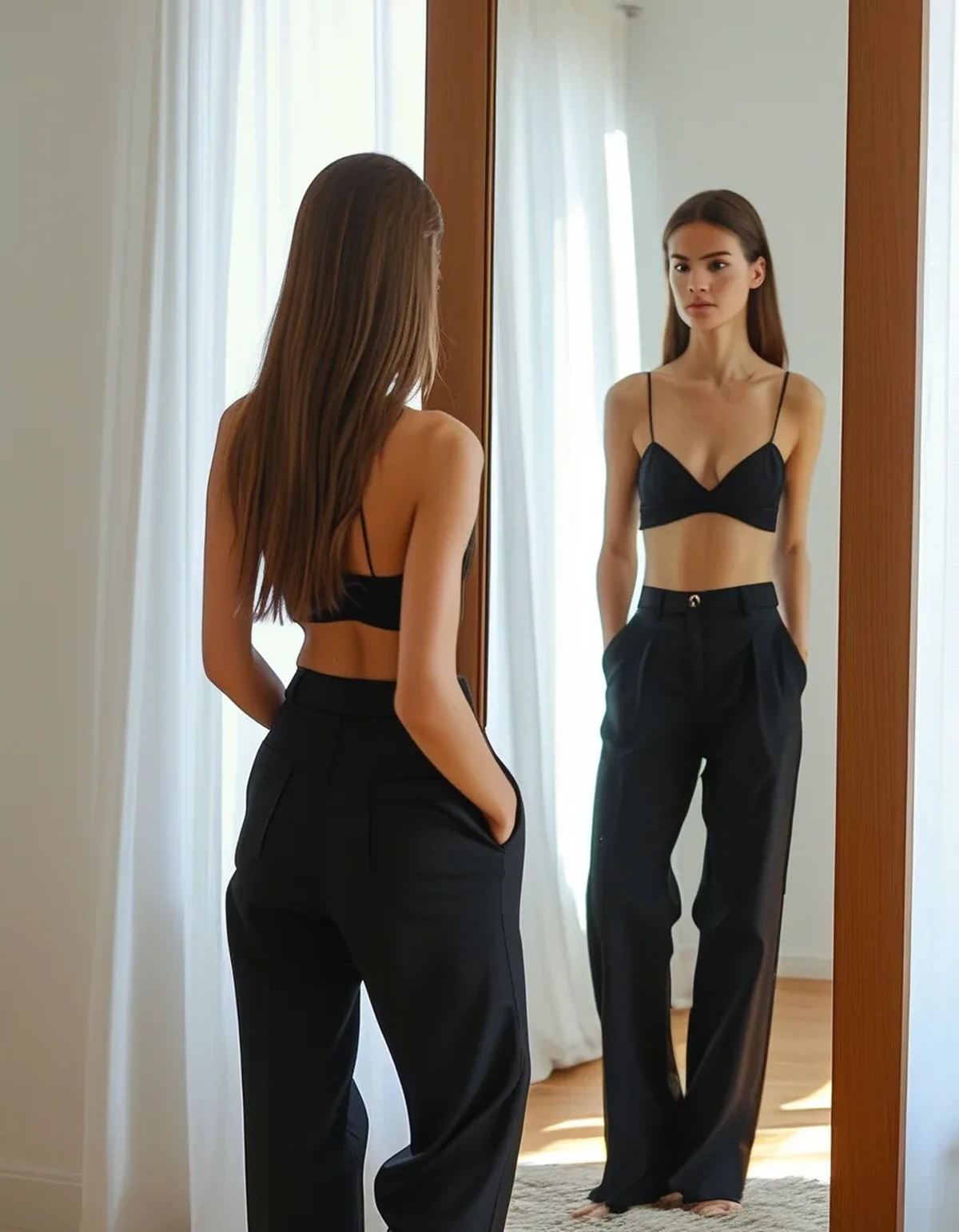
Quick Answer: A vertical seam or crease lengthens because it follows the leg’s actual three-dimensional shape and creates a single uninterrupted line. A printed stripe is flat, repeats, and is broken up by every fold in the fabric. One line reads as length; many lines read as pattern, and pattern draws the eye across rather than down. The most effective version is a single center crease or front seam on a straight or wide leg in a solid color, uninterrupted from waist to hem.
This is why tailored trousers do so much more for a petite frame than striped ones.
And why the number of lines matters more than the fact that they are vertical.
Why does one line work and many lines not?
Because the eye tracks a single continuous path and scans across a repeating one.
A single vertical element gives the gaze one route: down. It reads as a continuous length, and the eye travels its full extent without stopping.
A repeating pattern does the opposite. Stripes at regular intervals cause the eye to move horizontally between them, comparing and counting. The scan becomes lateral even though the elements are vertical, which is why closely spaced stripes can read as widening rather than lengthening.
And there is a physical problem with printed stripes. They are printed on a flat surface, then that surface wraps a three-dimensional leg. Every fold, drape, and curve bends the stripe - so the line the eye follows is not straight at all.
A seam or a pressed crease is different. It follows the garment’s construction, which follows the body. It stays vertical because it is built into the shape rather than applied on top of it.
The practical rule: fewer, longer lines beat more, shorter ones. One crease from waist to hem outperforms twenty stripes doing the same nominal job.
Which lines actually count?
More things read as a vertical line than most people realize, and they stack.
A pressed front crease. The classic, and still the most effective. It runs the full length of the leg, sits at the center, and does not break - the ideal case.
A center front or center back seam on a knit or a jean. Some leggings and trousers are cut with a genuine center seam, and it behaves the same way.
A side seam that runs uninterrupted. Weaker than a front crease because it sits at the edge, but real - especially with a contrast piping or a tuxedo stripe, which is a single line rather than a pattern.
The opening of a long open cardigan or coat. Two long vertical edges running the full height. This is one of the strongest lengthening tools available and it is not on the leg at all.
A column of a single color. Monochrome dressing works by removing every horizontal break, which is the same effect achieved by subtraction rather than addition.
And the ones that undo it: a cuff, a contrasting shoe, a horizontal seam at the knee, a patch pocket placed low. Any strong horizontal crossing your vertical line cuts it in two, and two short lines do not add up to one long one.
How do I set this up on a petite frame?
Five decisions, in order of impact.
1. Choose a straight or wide leg over a skinny. A straight leg holds a crease and presents a continuous shape. A skinny leg follows every curve, which bends any line it carries and creates its own visible horizontals at the knee and ankle.
2. Get the length right - to the top of the shoe or grazing the floor. A trouser that ends short creates a horizontal exactly where you want continuation. This matters more than the crease itself.
3. Actually press the crease. Many trousers are sold with one and lose it in the first wash. A pressed center crease is a five-minute intervention with a genuine visual return.
4. Match the shoe to the pant, or to your skin. The line should continue past the hem rather than stopping at it. A contrasting shoe is a horizontal at the end of your vertical.
5. Add the outer layer as a second vertical. An open long cardigan or coat gives two more full-length lines. Combined with the trouser crease, that is three continuous verticals and it is the strongest version of this available.
And keep the fabric in mind. A fabric with body holds a line; a very soft drape loses it. A mid-weight crepe, twill, or ponte carries a crease; a thin jersey does not.
Myth vs Fact: Vertical Lines and Height
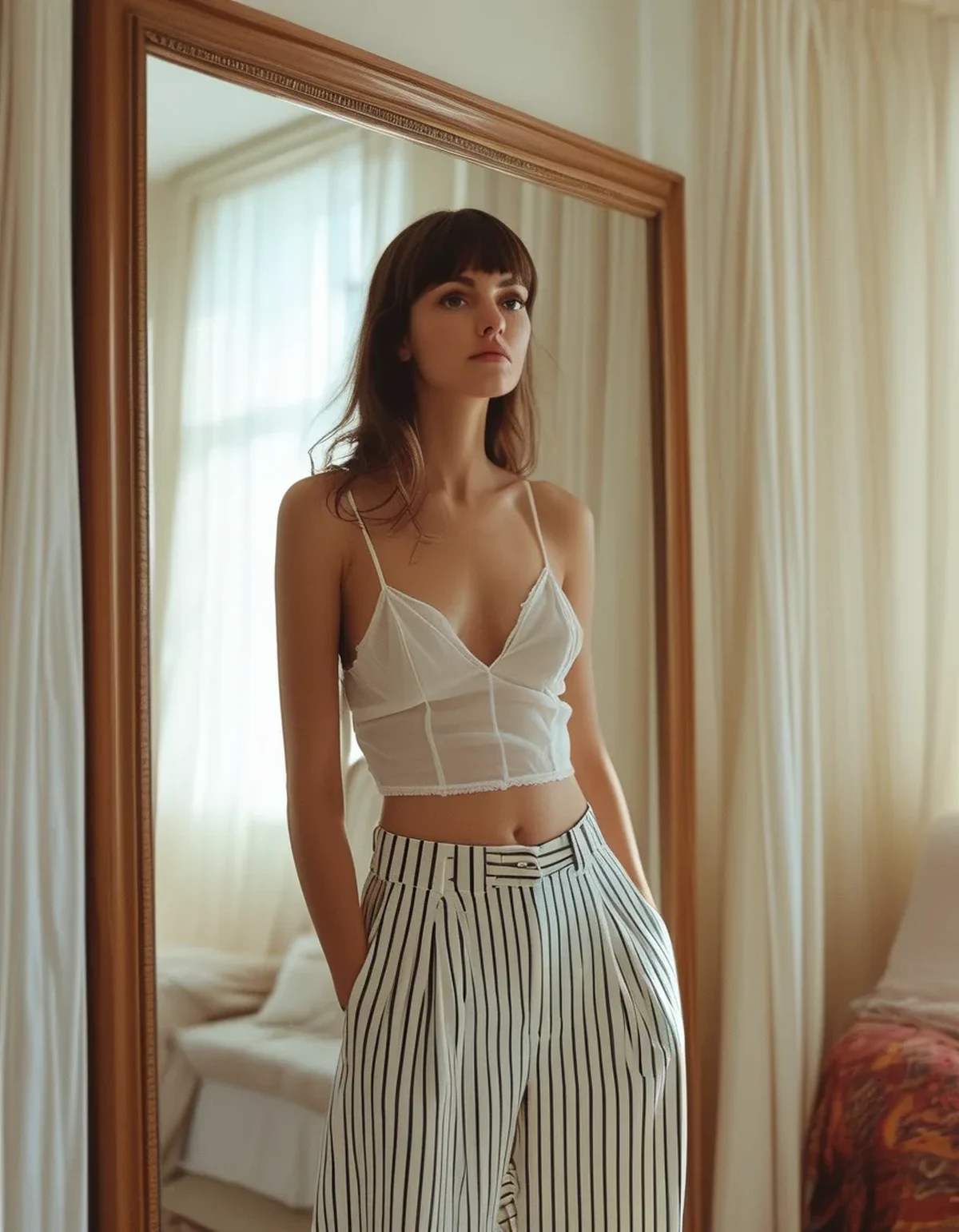
Myth: Vertical stripes always make you look taller. Fact: it depends entirely on spacing. Narrow, closely spaced stripes can read as widening, and the classic Helmholtz square illusion - where a square filled with vertical stripes can look wider rather than taller - has been demonstrated experimentally. Widely spaced stripes behave better.
Myth: Any vertical detail helps. Fact: a vertical detail that stops halfway does very little. Length of the uninterrupted line is what matters, not its direction alone.
Myth: Skinny jeans lengthen because they follow the leg. Fact: they show the leg’s true length, which is not the same as extending it. A straight leg with the right hem length usually reads longer because the visual column is uninterrupted.
Myth: You need a heel for the effect to work. Fact: the continuity of the line does most of the work. A flat shoe matching the trouser color outperforms a contrasting heel on this specific axis.
Myth: Monochrome means everything must be exactly the same shade. Fact: close shades in the same family work, and varied texture in one color family reads more deliberate than a flat match - which is also more achievable with real clothes.
How does this play out with fall layering?
Autumn gives you the best tools of the year and the most ways to break the line.
Long open outerwear is the season’s strongest lengthener. A duster, a long cardigan, or an unbuttoned coat provides two full-length verticals. Worn open, it lengthens; buttoned with a hem at mid-thigh, it cuts. The same garment does opposite jobs.
Tall boots can extend or destroy the line. In a color close to the trouser, a boot continues the column. In a contrasting shade, it draws a hard horizontal at the calf - which on a petite frame is the worst possible place for one.
Watch the sock gap. A flash of bare ankle or a contrasting sock between a cropped trouser and a boot is a bright horizontal interruption. Match the sock to the trouser or to the boot, never to neither.
Knits are the enemy of a crease. A heavy knit trouser will not hold one. In knit fabrics, rely on the monochrome column and the open-layer verticals instead - the mechanism is the same even when the crease is unavailable.
And scarves complicate things. A scarf hanging in two long vertical ends lengthens; one wrapped in a bulky horizontal at the neck shortens the whole frame. Let the ends hang long and straight.
FAQ: Vertical Line Questions, Answered
Do pinstripes work at all on a petite frame?
Yes, when they are widely spaced and on a well-fitting trouser. The failure case is narrow, closely spaced stripes on a loose garment, where folds break the lines and the spacing pulls the eye sideways.
Is a side stripe on athletic pants lengthening?
A single contrast side stripe running the full length works - it is one line, not a pattern. The version that fails is a short stripe that stops at the knee or a stripe interrupted by a pocket.
What if I cannot wear trousers with a crease to work?
Use the monochrome column and the open long layer instead. Same shade top to bottom with an open cardigan is as effective as a pressed crease, and it works with knits and casual fabrics where a crease is impossible.
TL;DR:
- One continuous line lengthens; many repeating lines read as pattern and pull the eye sideways.
- Seams and creases follow the body in three dimensions; printed stripes bend with every fold.
- Straight or wide legs hold a line; skinny legs bend it and add their own horizontals.
- Match the shoe to the trouser so the line continues past the hem instead of stopping at it.
- An open long layer adds two more full-length verticals - the strongest fall tool available.
Press a crease into the trousers you already own and try them with a matching shoe. It is the cheapest version of this and usually the most convincing.
See It in Motion
Seen here: High Waist Drawstring Wide Leg Yoga Pants with Pockets — shop it on bubblelime.com
Keep Reading
This article is for general informational and styling purposes only. Fit, sizing, and product availability may vary.
