Why a Cuffed Hem Lengthens Some Petite Legs and Shortens Others
Quick Answer: A cuff lengthens the leg when it ends at the narrowest visible point of your lower leg — usually just above the ankle bone — because it creates a clean break and shows skin at the leanest point. It shortens the leg when it lands at the widest part of the calf, because it draws a horizontal line at the widest point and visually stops the leg there. Your calf shape, not your height, determines which happens.
This is why the same cuff on the same trousers works beautifully on one person and looks stumpy on another, and why the advice to always cuff or never cuff is both half right.
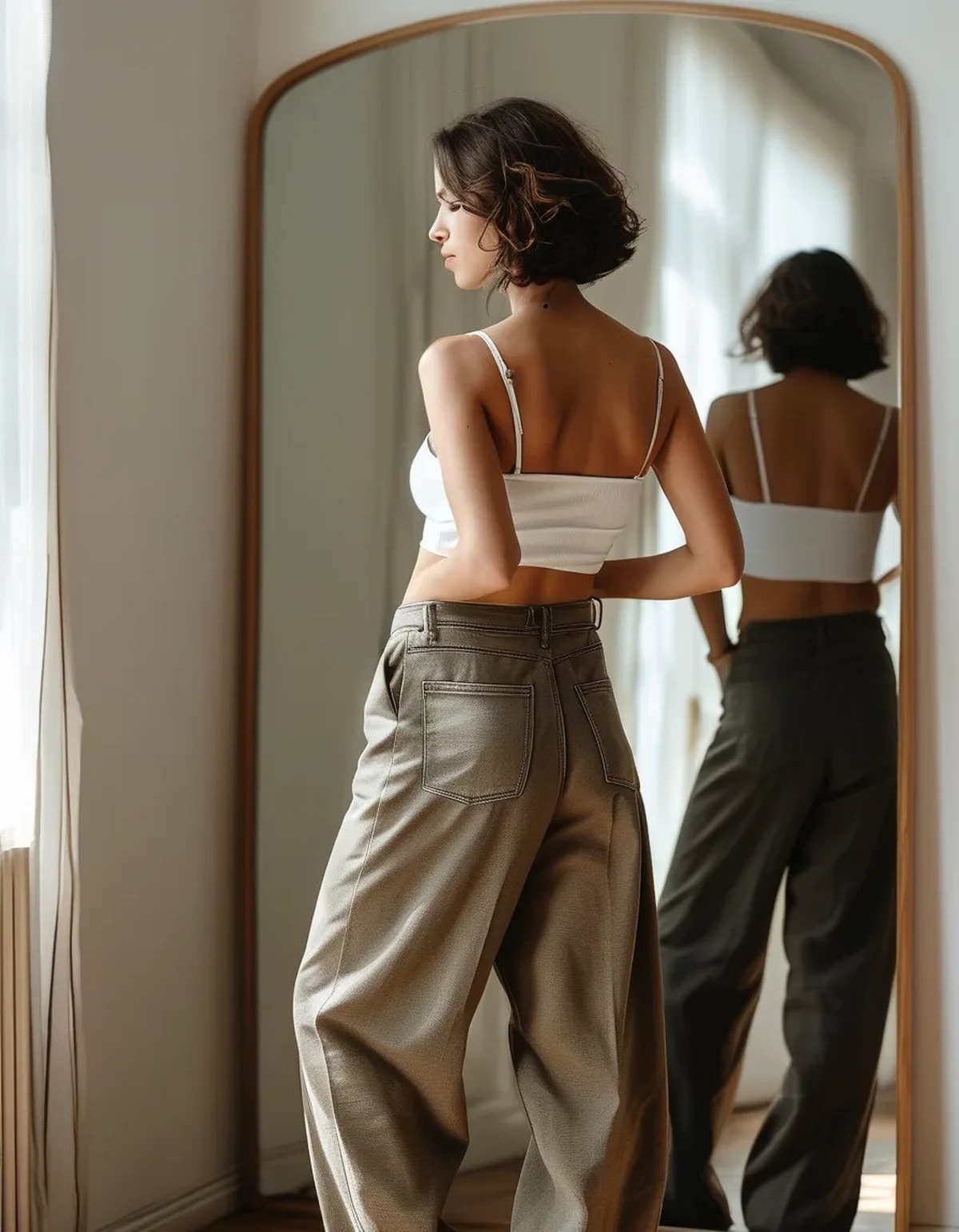
Where should a cuff actually end?
At the narrowest point of your lower leg, or below it. Never at the widest.
Run your hand down your calf from knee to ankle. You will find a clear widest point — usually the belly of the calf muscle, roughly a third of the way down — and a clear narrowest point just above the ankle bone. Those two locations are the entire decision.
A horizontal line at the narrowest point produces contrast. The eye reads the leg as tapering and continuing past the cuff into the ankle and foot, which extends the visual line.
A horizontal line at the widest point does the opposite. It emphasizes width at the widest place and terminates the eye’s travel there, which shortens the apparent leg and adds visual weight exactly where you do not want it.
The in-between zone — mid-calf — is the one that reads as an accident. It is neither a deliberate crop nor a full length, and it is the single most common cuffing error.
For most people, the reliable target is 1 to 3cm above the ankle bone, which shows the ankle without exposing so much leg that the trouser reads as too short.
Why does cuff depth matter as much as placement?
Because a cuff is not a line — it is a band with its own width.
A narrow cuff of 2cm reads almost as a plain hem, just with a slight visual weight at the bottom. It is the safest option and works on nearly every leg shape.
A deep cuff of 6cm or more is a design element. It adds a substantial block of doubled fabric at the ankle, which does two things: it visually widens the lower leg, and it consumes vertical space.
On a petite frame with limited leg length to spend, a deep cuff is expensive. It can still work — a single deep cuff on a wide-leg trouser is a genuine style — but it needs the rest of the outfit to compensate, usually with a high rise and a tucked or cropped top.
There is also a bulk consideration. Cuffing doubles or triples the fabric thickness at the hem. In heavy denim or thick twill, that creates real physical bulk that changes how the trouser hangs and can make a slim leg flare oddly at the ankle. In lighter fabric it lies flat and reads much cleaner.
The practical rule: the heavier the fabric, the shallower the cuff. A single narrow roll in heavy denim beats a double roll every time.
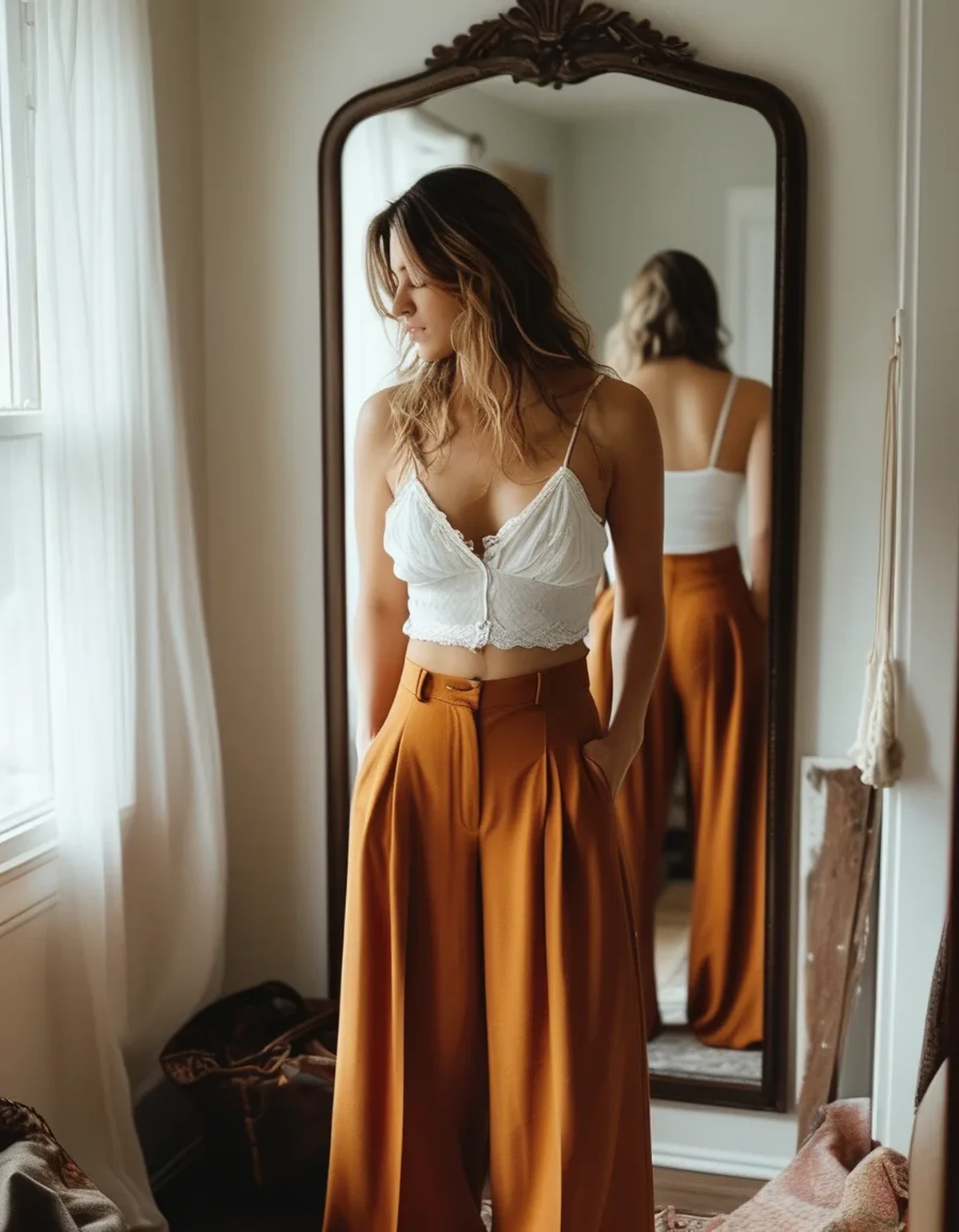
Myth vs Fact: Cuffing on a Petite Frame
Myth: Cuffing always makes you look shorter. Fact: Cuffing to just above the ankle bone reliably lengthens, because showing the narrowest part of the leg creates the taper that reads as length. It is placement, not cuffing itself.
Myth: You should just get them hemmed instead. Fact: Hemming is better for trousers you wear often, and it removes the bulk problem entirely. But hemming is permanent, and a cuff lets you change the break with different shoes — which is a genuine advantage for a shoe wardrobe with varied heel heights.
Myth: Wide-leg trousers should never be cuffed. Fact: A single deep cuff on a wide leg is a classic and works well when the rise is high. What does not work is a narrow roll on a wide leg, which looks like the trousers are too long and you did something about it.
Myth: Cuffs are casual only. Fact: A turn-up on a tailored trouser is a traditional detail and reads as considered. What makes a cuff read casual is uneven rolling, not the cuff itself.
Myth: The same cuff works year-round. Fact: As boots enter the wardrobe, cuff placement has to move. A cuff that sits perfectly above a low shoe disappears into a boot shaft or, worse, creates a bulge inside it. Autumn generally calls for either a shallower cuff or none.
How do shoes change the calculation?
Substantially, and this is where most cuffing decisions actually go wrong.
With a low, minimal shoe — a flat, a low sneaker, a loafer — the cuff at the ankle bone works ideally. The ankle and part of the foot are visible, the taper continues, and the leg line runs uninterrupted into the shoe.
With a chunky sneaker, the shoe itself is visually heavy. A cuff that stops well above it creates a gap of bare ankle between two heavy elements, which fragments the line. Either cuff lower so the trouser meets the shoe, or lean into the gap deliberately with a sock that matches the trouser.
With an ankle boot, the cuff usually needs to go. The boot shaft and the cuff compete for the same space, and the result is bulk at the ankle plus a hard horizontal line at the boot top — often the exact widest point of the calf. This is the most common autumn proportion failure.
With a heel, you have more room. The heel adds height, which effectively creates more leg to work with, so a slightly deeper cuff or a slightly higher placement becomes viable.
And the sock question, which matters more than people think: a sock matching the trouser continues the line; a contrasting sock creates a second horizontal break right after the cuff, doubling the shortening effect. If you cuff and wear a visible contrasting sock, the two work against each other.
FAQ: Cuffing Questions, Answered
How many rolls is right?
One, done at the depth you want. Two thin rolls create two lines and read as improvised. If you want depth, make one deep roll rather than stacking.
Should the cuff be the same on both legs?
Yes, and it is worth checking in a mirror rather than assuming. Uneven cuffs are the difference between a styling choice and an oversight, and they are surprisingly hard to feel.
What about cuffing leggings or joggers?
Joggers usually have an elasticated cuff already, and rolling it defeats the design. Leggings should not be cuffed — the doubled fabric creates a tight band that digs in and distorts the line.
TL;DR:
- Cuff to the narrowest point of your lower leg — usually 1 to 3cm above the ankle bone.
- Never cuff at the widest part of your calf; mid-calf reads as an accident.
- The heavier the fabric, the shallower the cuff; one deep roll beats two thin ones.
- With ankle boots, drop the cuff entirely, and match your sock to the trouser if it will show.
Find your narrowest point with your hand right now. Every cuffing decision you make from here is just that measurement plus your shoe.
See It in Motion
Seen here: High Waist Drawstring Wide Leg Yoga Pants with Pockets — shop it on bubblelime.com
Keep Reading
This article is for general informational and styling purposes only. Fit, sizing, and product availability may vary.
