High-Waisted vs Mid-Rise: Which One Actually Lengthens Petite Legs More?
Quick Answer: High-waisted bottoms generally create a longer leg line than mid-rise for most petite frames, because they shift the visual starting point of the leg higher, but the effect depends on where the rise sits relative to your torso-to-leg ratio specifically.
The high-waist-lengthens-legs rule gets repeated so often it’s treated as universal, but it doesn’t play out identically on every petite frame.

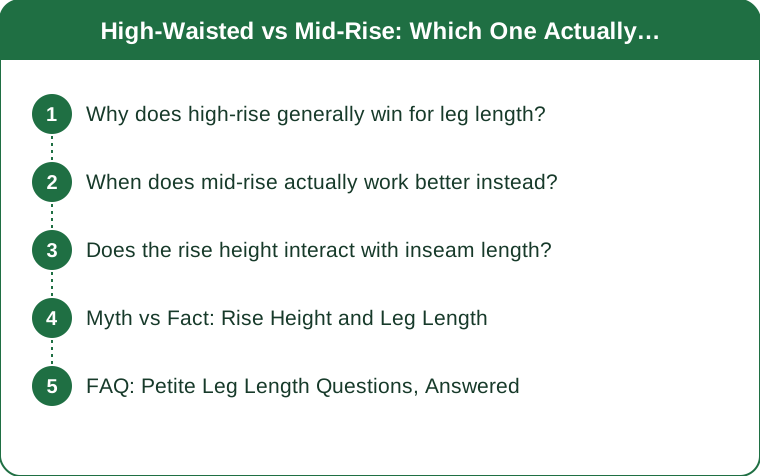
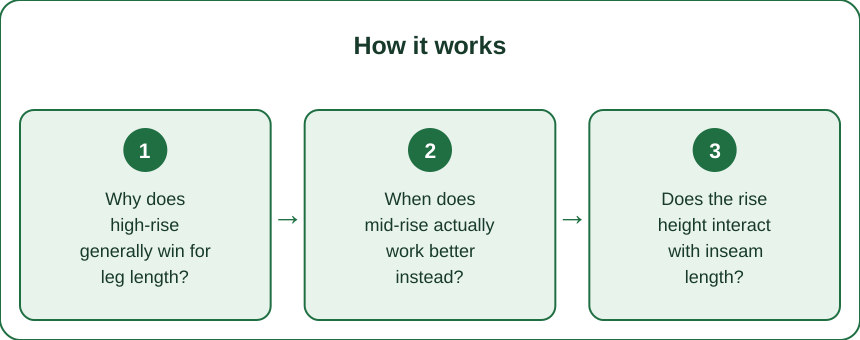
Why does high-rise generally win for leg length?
The core mechanic is simple: the eye reads “leg” as starting wherever the bottom’s waistband sits, not where your anatomical hip actually is. A high-rise waistband that sits at or above the natural waistline moves that starting point up, which mathematically lengthens the visual leg portion of your silhouette even though your actual leg length hasn’t changed at all.
When does mid-rise actually work better instead?
For petite frames with a shorter torso relative to leg length, a very high rise can sometimes look like it’s swallowing the torso, making the upper body look compressed even as the legs look longer. In that specific proportion type, a well-placed mid-rise — paired with a cropped top to expose a sliver of natural waist — can sometimes balance the frame better than maximum-height rise.

Does the rise height interact with inseam length?
Yes, significantly. A high-rise pant with a full-length inseam that pools at the ankle cancels out the lengthening effect the rise created — the leg line gets visually cut off again at the ankle. Pairing high-rise with an ankle-length or slightly cropped inseam, hemmed to hit right at or just above the ankle bone, keeps the elongating effect intact all the way down.
Myth vs Fact: Rise Height and Leg Length
Myth: The higher the rise, the longer the legs look, no matter what. Fact: Past a certain point, an extremely high rise can compress the torso on some proportions, working against the intended effect.
Myth: Mid-rise never works for lengthening petite legs. Fact: With the right inseam and top pairing, mid-rise can still create a long leg line — rise height is one variable among several.
Myth: Rise height matters more than inseam length. Fact: They work together — a great rise with a poorly hemmed inseam loses much of its benefit.
FAQ: Petite Leg Length Questions, Answered
How do I know if my torso is short or long relative to my legs?
A rough gauge: sit on a chair and measure from the seat to the top of your head, then stand and measure floor to hip — if the seated measurement is proportionally larger, you likely have a shorter torso, which tends to favor slightly less extreme rise heights.
Does this rule apply to skirts too?
Yes — a high-waisted skirt follows the same visual-starting-point logic as pants, lengthening the leg line below it.
What’s the single most impactful fix if I only change one thing?
Hemming inseam length to hit right at the ankle bone tends to have the biggest visible impact, often more than rise height alone.
TL;DR:
- High-rise generally lengthens petite legs more by moving the visual leg starting point up
- Shorter-torso proportions sometimes look better in a well-chosen mid-rise instead
- Inseam length has to match — a pooling hem cancels out a great rise
- Hemming to the ankle bone is often the single highest-impact fix
Try both rises with the same hemmed inseam length next time you’re deciding — the comparison only means something when the other variables are held constant.
Keep Reading
This article is for general informational and styling purposes only. Fit, sizing, and product availability may vary.
